Insights
Longevity by Design: How Mirai Group Japan Is Engineering the Future of Skin Science
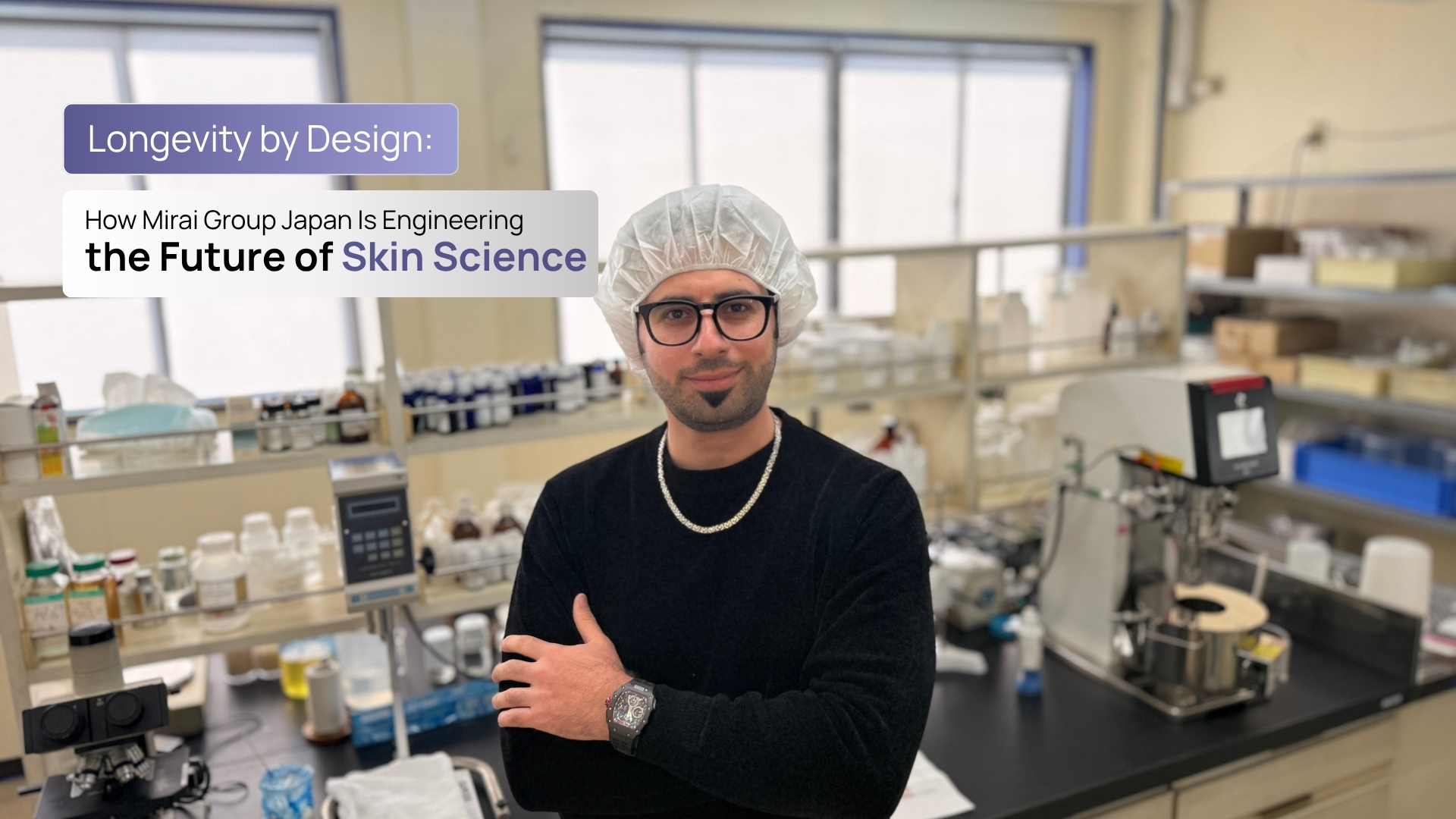
Longevity is skincare's biggest scientific shift, and Mirai Group Japan has been building for it since 2014. CEO and Head of R&D Ismail Zein El Dine breaks down the technology, the products, and the strategy behind the brand's rapid growth in Indonesia.
#mgj-longevity-article, #mgj-longevity-article * { box-sizing: border-box; } #mgj-longevity-article { --mgj-bg: #F3EFEC; --mgj-text: #4A4A4A; --mgj-accent: #595790; --mgj-accent-tint: rgba(89,87,144,0.08); --mgj-accent-tint-strong: rgba(89,87,144,0.14); --mgj-black: #000000; --mgj-silver-light: #E6E7E8; --mgj-white: #FFFFFF; color: var(--mgj-text); font-family: -apple-system, BlinkMacSystemFont, "Segoe UI", Roboto, "Helvetica Neue", Arial, sans-serif; line-height: 1.7; font-size: 17px; } #mgj-longevity-article .mgj-la-page { padding: 40px 16px 64px; background: var(--mgj-bg); } #mgj-longevity-article .mgj-la-card { max-width: 800px; margin: 0 auto; background: var(--mgj-white); border-radius: 20px; padding: 48px 40px 56px; box-shadow: 0 1px 3px rgba(0,0,0,0.04); } @media (max-width: 600px) { #mgj-longevity-article .mgj-la-card { padding: 32px 20px 40px; border-radius: 14px; } #mgj-longevity-article { font-size: 16px; } } #mgj-longevity-article .mgj-la-kicker { color: var(--mgj-text); text-transform: uppercase; letter-spacing: 0.14em; font-size: 12.5px; font-weight: 700; margin: 0 0 14px; } #mgj-longevity-article h1 { color: var(--mgj-accent); font-size: 2.15em; line-height: 1.22; margin: 0 0 18px; font-weight: 800; } #mgj-longevity-article h2 { color: var(--mgj-accent); font-size: 1.5em; line-height: 1.3; margin: 44px 0 16px; font-weight: 800; scroll-margin-top: 20px; } #mgj-longevity-article h3 { color: var(--mgj-accent); font-size: 1.18em; margin: 28px 0 10px; font-weight: 700; scroll-margin-top: 20px; } #mgj-longevity-article h4, #mgj-longevity-article h5 { color: var(--mgj-text); font-weight: 700; } #mgj-longevity-article .mgj-la-byline { color: var(--mgj-text); font-size: 0.95em; margin: 0 0 28px; padding-bottom: 24px; border-bottom: 1px solid var(--mgj-silver-light); } #mgj-longevity-article .mgj-la-lead { font-size: 1.12em; color: var(--mgj-text); } #mgj-longevity-article p { color: var(--mgj-text); margin: 0 0 18px; } #mgj-longevity-article a { color: var(--mgj-accent); text-decoration: none; } #mgj-longevity-article a:hover { text-decoration: underline; } #mgj-longevity-article strong { color: inherit; } #mgj-longevity-article ul, #mgj-longevity-article ol { color: var(--mgj-text); padding-left: 22px; margin: 0 0 18px; } #mgj-longevity-article li { margin-bottom: 8px; } #mgj-longevity-article hr { border: none; border-top: 1px solid var(--mgj-silver-light); margin: 40px 0; } #mgj-longevity-article blockquote { border-left: 4px solid var(--mgj-accent); margin: 28px 0; padding: 4px 0 4px 22px; color: var(--mgj-text); font-size: 1.08em; font-style: italic; } #mgj-longevity-article blockquote cite { display: block; margin-top: 10px; font-style: normal; font-size: 0.85em; color: var(--mgj-text); opacity: 0.85; } #mgj-longevity-article .mgj-la-toc { background: var(--mgj-white); border: 1px solid var(--mgj-silver-light); border-left: 4px solid var(--mgj-accent); border-radius: 10px; padding: 22px 24px; margin: 30px 0 38px; } #mgj-longevity-article .mgj-la-toc-heading { color: var(--mgj-accent); font-weight: 800; text-transform: uppercase; letter-spacing: 0.08em; font-size: 0.85em; margin: 0 0 12px; } #mgj-longevity-article .mgj-la-toc ul { margin: 0; padding-left: 18px; } #mgj-longevity-article .mgj-la-toc li { margin-bottom: 7px; } #mgj-longevity-article .mgj-la-toc a { color: var(--mgj-accent); } #mgj-longevity-article .mgj-la-toc a:hover { color: var(--mgj-text); text-decoration: underline; } #mgj-longevity-article .mgj-la-callout { background: var(--mgj-accent-tint); border: 1px solid var(--mgj-accent); border-radius: 10px; padding: 18px 22px; margin: 24px 0; color: var(--mgj-text); } #mgj-longevity-article .mgj-la-callout p:last-child { margin-bottom: 0; } #mgj-longevity-article .mgj-la-callout-label { color: var(--mgj-accent); font-weight: 800; text-transform: uppercase; letter-spacing: 0.06em; font-size: 0.78em; margin: 0 0 8px; } #mgj-longevity-article .mgj-la-table-wrap { overflow-x: auto; border: 1px solid var(--mgj-silver-light); border-radius: 10px; background: var(--mgj-white); margin: 22px 0 30px; } #mgj-longevity-article table { width: 100%; border-collapse: collapse; min-width: 620px; } #mgj-longevity-article thead th { background: var(--mgj-accent); color: var(--mgj-white); text-align: left; padding: 13px 16px; font-size: 0.92em; font-weight: 700; } #mgj-longevity-article tbody td { padding: 14px 16px; color: var(--mgj-text); border-bottom: 1px solid var(--mgj-silver-light); font-size: 0.95em; vertical-align: top; } #mgj-longevity-article tbody tr:last-child td { border-bottom: none; } #mgj-longevity-article tbody tr:hover { background: var(--mgj-accent-tint); } #mgj-longevity-article .mgj-la-accent { color: var(--mgj-accent); } #mgj-longevity-article .mgj-la-faq-item { border: 1px solid var(--mgj-silver-light); border-radius: 10px; margin-bottom: 12px; overflow: hidden; background: var(--mgj-white); } #mgj-longevity-article .mgj-la-faq-item summary { background: var(--mgj-accent-tint-strong); color: var(--mgj-black); padding: 15px 20px; font-weight: 700; cursor: pointer; list-style: none; display: flex; justify-content: space-between; align-items: center; gap: 12px; } #mgj-longevity-article .mgj-la-faq-item summary::-webkit-details-marker { display: none; } #mgj-longevity-article .mgj-la-faq-item summary::after { content: "+"; color: var(--mgj-accent); font-size: 1.3em; font-weight: 800; flex-shrink: 0; transition: transform 0.15s ease; } #mgj-longevity-article .mgj-la-faq-item[open] summary::after { transform: rotate(45deg); } #mgj-longevity-article .mgj-la-faq-body { background: var(--mgj-white); color: var(--mgj-text); padding: 16px 20px 20px; } #mgj-longevity-article .mgj-la-faq-body p { margin: 0; } #mgj-longevity-article .mgj-la-resources li { margin-bottom: 10px; } #mgj-longevity-article .mgj-la-res-desc { color: var(--mgj-text); opacity: 0.85; } #mgj-longevity-article .mgj-la-cta-box { background: var(--mgj-accent-tint); border: 1px solid var(--mgj-accent); border-radius: 14px; padding: 30px 28px; text-align: center; margin: 40px 0 8px; } #mgj-longevity-article .mgj-la-cta-box p { margin: 0 0 18px; font-size: 1.05em; } #mgj-longevity-article .mgj-la-btn { display: inline-block; background: var(--mgj-accent); color: var(--mgj-white) !important; border: 1px solid var(--mgj-accent); padding: 13px 28px; border-radius: 999px; font-weight: 700; text-decoration: none; } #mgj-longevity-article .mgj-la-btn:hover { text-decoration: none; opacity: 0.92; } #mgj-longevity-article kbd, #mgj-longevity-article code { background: var(--mgj-silver-light); color: var(--mgj-text); border-radius: 4px; padding: 2px 6px; font-size: 0.9em; } #mgj-longevity-article .mgj-la-footnote { color: var(--mgj-text); font-size: 0.85em; opacity: 0.8; } Longevity & Innovation Longevity by Design: How Mirai Group Japan Is Engineering the Future of Skin Science By Ismail Zein El Dine, Founder, CEO and Head of Research & Development, Mirai Group Japan · August 31, 2026 · 8 min read Longevity has become the most searched word in skincare, and for once, the science behind it is real. It marks a genuine shift in what skincare is meant to do: not simply hide the signs of aging after they appear, but keep skin cells functioning well for longer. This is the exact science Mirai Group Japan has built products around since 2014, and it is now the strategy behind the company's fastest-growing international market, Indonesia. In this article The science redefining aging skin Mirai Group Japan's approach to longevity Three products, one longevity philosophy Product comparison How markets are responding Case study: Indonesia The strategy behind the growth What comes next Frequently asked questions Resources The Science Redefining Aging Skin For most of the industry's history, "anti-aging" meant treating what had already gone wrong: fading a wrinkle, correcting a dark spot, replacing volume that time had taken away. Longevity science asks a different question. What if the goal is to keep skin cells working well for longer, rather than repairing the damage after it shows? The shift is grounded in a small number of well-studied mechanisms. As skin ages, fibroblasts, the cells responsible for producing collagen, elastin and hyaluronan, slow down and, in many cases, stop dividing altogether. This state is known as cellular senescence, and senescent cells do more than stop producing structural proteins; they release inflammatory signals that accelerate aging in the tissue around them. Two other systems decline alongside it: DNA repair capacity, coordinated in part by proteins such as SIRT6, which can fall by roughly 70 percent in aged skin cells, and mitochondrial energy production, tied to declining NAD+ availability. UV exposure and oxidative stress accelerate all three at once. This is why the newest wave of skincare research has moved away from single-ingredient marketing, a retinol here, a vitamin C there, toward biological signal technology: growth factors, peptides and stress-response proteins that communicate with the cell directly. Mirai Group Japan has worked in exactly this space, growth factor and peptide biology aimed at cellular function, since 2014, putting its core research roughly a decade ahead of where the wider market is only now arriving. Mirai Group Japan's Approach to Longevity Mirai Group Japan was founded in Tokyo in 2014 on a simple operating principle: science should visibly work. In practice, that meant refusing to let a product's marketing outrun its formulation, and it meant investing in the kind of raw ingredient development that most skincare companies buy off the shelf rather than build themselves. The company's first major undertaking was a 20 percent ADSC-CM concentrate, a human adipocyte-derived stem cell conditioned media technology, at a concentration well above the industry norm. It was developed more than a decade ago, years before biotech skincare became a category consumers actively searched for. That early work became the foundation of the Majestic Cosme line and set a pattern the company has repeated since: build the ingredient technology first, validate the mechanism, then bring it to market. Two of the company's active ingredients, Acnobet and Hairen, are peptides Mirai Group Japan developed and formally registered itself, believed to be among the first bio-peptides of their kind formulated in Japan. "We do not license someone else's active ingredient and put our name on the bottle. If we cannot explain, in plain language, exactly which cell process a product changes and why, it does not leave the lab." Ismail Zein El Dine, Founder, CEO and Head of R&D, Mirai Group Japan That standard is what separates a longevity strategy from a longevity marketing campaign, and why the company's range stays deliberately narrow: three flagship products, each built around one clearly explainable mechanism. Three Products, One Longevity Philosophy Longevity is a research philosophy, but customers experience it through products. Taken together, Mirai Group Japan's three flagship formulas show how the strategy works in practice: identify a specific cellular mechanism, build or register the technology to act on it, then validate the result before it reaches a shelf. Majestic Skin: The Structural Reset As fibroblasts slow with age and cumulative UV exposure, collagen, elastin and hyaluronan production drops, and skin loses tension, density and volume, while deep lines and old acne scarring become more visible. Majestic Skin's answer is a 20 percent ADSC-CM concentrate carrying more than 150 growth factors, including VEGF, TGF, FGF and IGF, delivered through liposome encapsulation and manufactured in a cold process that protects those proteins from heat degradation. The growth factors act as bio-signals that reactivate dormant fibroblasts, restarting the skin's own production of collagen, elastin and hyaluronan rather than supplying a synthetic substitute. Most users report visible change within 14 days, well inside the multi-month timelines typical of conventional anti-aging actives. Majestic Active Repair: Calming Active Skin, Without Compromise Acne moves through four stages, excess sebum, blocked pores, bacterial inflammation and post-inflammatory scarring, and most treatments are built for only one, which is why so many acne products under-treat or over-strip the skin. Active Repair combines EGF and copper peptide with Acnobet and Hairen in a 100 percent nano-processed, fragrance-free, alcohol-free formula. Hairen's core active is azelaic acid, effective against inflammation and pigmentation but often too irritating at a working dose; the copper peptide is included specifically to buffer that irritation, allowing a higher dose without the usual dryness and peeling. Majestic Day Repair: Defending Against Tomorrow's Damage Every mechanism above, senescence, DNA damage, declining growth factor signaling, is accelerated by daily UV exposure, so a longevity strategy has to start with prevention, not only repair. Day Repair is a broad-spectrum SPF20 PA++ mineral formula, using titanium dioxide and zinc oxide rather than chemical filters, paired with HSP (heat shock protein) technology supporting the skin's own DNA and protein repair, an ASP complex that interrupts the pigmentation signal, and a 3GF blend of EGF, FGF and IGF. The SPF20 rating is deliberate: it already blocks roughly 95 percent of UVB rays against SPF30's 96.7 percent and SPF50's 98 percent, a diminishing-returns curve that makes SPF20 practical for genuine daily, year-round use rather than an occasional beach sunscreen. Product Comparison Product Core Technology Longevity Mechanism Best For Majestic Skin 5 ml serum 20% ADSC-CM, 150+ growth factors (VEGF, TGF, FGF, IGF), liposome delivery, cold-process manufacture Reactivates dormant fibroblasts to restart collagen, elastin and hyaluronan production Structural aging, deep lines, loss of firmness, old acne scarring Majestic Active Repair 20 ml essence EGF, copper peptide, Acnobet and Hairen (registered bio-peptides), 100% nano-processed Targets all four stages of acne while copper peptide buffers azelaic acid irritation Active breakouts, congestion, post-acne marks, sensitized skin Majestic Day Repair 50 ml cream Mineral SPF20 PA++, HSP, ASP complex, 3GF (EGF, FGF, IGF) Blocks ~95% of UVB while supporting DNA/protein repair and blocking pigment signaling Daily photo-aging prevention, uneven tone, makeup-ready base How Markets Are Responding The market's response has been unusually fast for an industry that typically moves slowly past retinol and vitamin C. Longevity has become one of the most active categories at global formulation events, and analysts increasingly treat it as a distinct segment from conventional anti-aging, built around ingredients that work at the cellular level rather than surface exfoliation or hydration alone. Indonesia illustrates the pattern at a market level. The country's skin care market alone is projected to reach roughly US$3.19 billion in 2026, growing close to 6.9 percent year over year, and a meaningful share of that growth is coming from consumers who now research the science behind a product before buying it. That is the exact customer Mirai Group Japan built Majestic Cosme for, and it is one reason every SKU the company sells in Indonesia carries full BPOM regulatory approval before it reaches a shelf. In a longevity-literate market, trust is earned at the ingredient level, not only the marketing level. Why this matters A market that is willing to ask "what does this ingredient actually do" is a market that rewards companies willing to answer in detail. That is the specific advantage Mirai Group Japan built its R&D process around, years before longevity became a mainstream search term. Case Study: Indonesia Japanese skincare is not new to Indonesia. Brands such as Shiseido, SK-II and Hada Labo have operated in the country for years, and Japanese formulation is already a trusted signal for Indonesian skincare buyers. Mirai Group Japan chose to enter that crowded, established field anyway, through its Indonesian legal entity, PT Mirai Group Japan, and the results have made it one of the fastest-growing Japanese skincare brands in the country. Majestic Cosme's official Indonesian retail launch, through Boots, began on December 8, 2025. In under a year, the brand expanded to seven Boots locations, alongside Sogo, Seibu and Century, and is now in active discussions to add several more of Indonesia's leading retail chains. The growth has been driven less by advertising spend than by direct education: in-store Beauty Talks pairing two practicing aesthetic doctors with 35 to 60 attendees, walking through the science of UV filters, acne mechanisms and growth factor technology, then connecting it to the products on the shelf beside them. Several of the doctors involved now prescribe Majestic Active Repair to their own patients, and content from these events has passed 300,000 views on social media. A note on regulatory naming Indonesian cosmetic regulation classifies Majestic Skin's active technology under a peptide framework rather than a stem cell one, so in-market materials describe it as SH-Polypeptide 11 (Peptida Bio-Identik Kompleks): the same underlying growth factor technology, named to match Indonesia's regulatory standard rather than the global one. It is a small detail, but it says something about how the company operates. The formulation does not change from market to market. The compliance work does. The bigger point is strategic, not promotional. Indonesia is the clearest proof that Mirai Group Japan's model, cellular-mechanism research paired with doctor-led, regulation-correct market entry, travels. It is now the template the company applies as it deepens its presence across Japan, the UAE, Lebanon, Vietnam and India. The Strategy Behind the Growth Behind both the product technology and the market strategy is one person doing both jobs. Ismail Zein El Dine founded Mirai Group Japan in Tokyo and serves as both CEO and Head of Research & Development, an unusual combination in an industry where the person setting business strategy and the person designing the formula are rarely the same. Lebanese by background and based in Japan for more than sixteen years, he treats that dual role as the company's real advantage, not a staffing gap: product decisions and market decisions are made by the same person, against the same standard. "A CEO can approve a good marketing story. A head of R&D can only approve what the data supports. I don't get to choose one over the other. Every product we ship has to satisfy both jobs at once." Ismail Zein El Dine, Founder, CEO and Head of R&D, Mirai Group Japan That standard is visible in how the Indonesia strategy was built: not a translated version of the Japanese or international brand, but its own compliant, doctor-led market entry, designed by the same team that designed the products it sells. What Comes Next Longevity science is still early, and Mirai Group Japan's near-term plan is to deepen the same playbook in every market it operates: cellular-mechanism research first, regulation-correct formulation second, doctor-led, evidence-first education third. If skin longevity turns out to be a genuine decade-long scientific shift rather than a passing trend, the company sees the current moment less as a peak and more as the point where the rest of the market is only now catching up to work it started in 2014. Frequently Asked Questions What is skin longevity, and how is it different from anti-aging? Traditional anti-aging treats visible signs after they appear, such as a wrinkle or a dark spot. Skin longevity targets the underlying cellular processes, including cellular senescence, DNA repair and growth factor signaling, that cause those signs to appear in the first place, aiming to keep skin cells functioning well for longer rather than only correcting damage after the fact. What makes Mirai Group Japan's technology different from typical anti-aging ingredients? Rather than licensing off-the-shelf actives, Mirai Group Japan develops and registers its own ingredient technology, including a 20 percent ADSC-CM growth factor concentrate and the Acnobet and Hairen peptides, and builds each product around a specific, explainable cellular mechanism instead of a single trending ingredient. How quickly do Majestic Cosme products show results? Timelines vary by product and concern, but Majestic Skin's growth factor technology is formulated to show visible change within 14 days, faster than the multi-month timelines typical of conventional anti-aging actives, because it reactivates the skin's own collagen-producing fibroblasts rather than waiting for gradual surface renewal. Why did Mirai Group Japan choose Indonesia as a key growth market? Indonesia already trusts Japanese skincare, has a fast-growing skin care market projected near US$3.19 billion in 2026, and rewards brands that can prove their science through credible channels such as dermatologist partnerships, which matches the evidence-led positioning Mirai Group Japan was built around. Are Majestic Cosme products regulated and safe for sensitive skin? Every SKU sold in the Indonesian market carries full BPOM approval. Formulations are built to reduce irritation; for example, the copper peptide in Majestic Active Repair is included specifically to buffer the azelaic acid in Hairen, so it can be used at an effective dose without the dryness and peeling that ingredient often causes on its own. Where can I learn more or purchase Majestic Cosme products? The full product range, ingredient breakdowns and clinical detail are published at majesticcosme.com , alongside the retail partners currently carrying the brand in each market. See the full ingredient breakdowns, clinical detail and product range behind everything covered in this article. Explore Majestic Cosme Resources Majestic Cosme , full product and technology overview, including Majestic Skin, Majestic Active Repair and Majestic Day Repair. Majestic Skin product page , ADSC-CM growth factor serum formulation detail. Advancing Skincare With Regenerative Technology , Majestic Cosme Journal. Indonesia Skin Care Market Forecast , Statista Market Insights. Skin Longevity 2026: SIRT6 and Functional Skincare , Grand Ingredients. Longevity Beauty in 2026: The Future of Anti-Aging Skincare , Forbes. Published by Mirai Group Japan. This article reflects the company's current product formulations, retail partnerships and market data as of August 2026 and is intended for general educational purposes; it is not medical advice.